The Importance of Place.
Part 3 – Papua New Guinea.

When I wrote about Papua New Guinea in Never Still, I wrote as my twenty-five-year-old self. I remembered what happened, how I felt, and the decisions I made with the understanding I had then.
Rereading it now, forty-six years later, I find myself reading with a different lens.
I thought I had gone to Papua New Guinea to be a doctor.
Instead, I now see, that I went there to become an adult.
Not in the cinematic way we imagine adulthood arriving—with one defining moment, one triumphant decision. Mine accumulated quietly through a series of small humiliations, difficult choices, disappointments, and unexpected revelations.
It was there that life stopped being black and white.
*****
I arrived with an eighteen-month-old on my hip and the shaky courage that can disguise itself as confidence. I had completed my internship, finalized my divorce, obtained legal permission to take my daughter out of the country, and accepted a three-year CUSO posting at a German Catholic mission hospital in East New Britain Province.
This was pre- Internet. When there were no overseas phone calls. Letters took six weeks to travel in each direction.
Far, far away; stationed in a foreign culture.
No one was coming to save me.
****
The German sisters who ran Vunapope Hospital were a force.
They had arrived before the Second World War believing they would never return home. Their commitment was steadfast. Their standards were uncompromising. Every morning before dawn, nurses swept the hospital grounds before beginning their shifts.
Everything had its place.
I admired them enormously.
I also discovered they were human.
Until then, my Church had been prayer and sacraments. At Vunapope hospital it became personalities, hierarchy, politics, generosity, stubbornness, compassion and judgment—all.
It was my first realization that institutions are simply collections of imperfect people trying, and sometimes failing, to do good. And that the Catholic Church was an institution.
That has stayed with me.

****
Medicine became another teacher.
After a brief orientation, I found myself responsible for female medical, pediatric and obstetrical wards.
I knew how much I didn't know and often found myself in a room where I was the person who knew the most.
There were no specialists to consult and few investigations available. I couldn't afford to display uncertainty.
So, I learned a question that continues to guide me.
What is the best thing I can do for this person under these circumstances?
****
One lesson arrived disguised as a man.
A senior physician spent a year quietly undermining my confidence. Professionally. Personally. When I confronted him, he denied everything.
For years afterwards, I searched for an explanation.
Eventually I stopped.
Some people wound others because they can.
The important lesson wasn't learning who he was.
It was learning not to surrender my sense of self to someone else's opinion.
A useful lesson.
*****
The people of ENBP were clustered in groups and interconnected.
Traditional Indigenous communities. Australian plantation owners. Chinese shopkeepers. Missionaries. Volunteers from half a dozen countries.
I discovered that I could move easily among them all.
What I couldn't yet do was remain completely myself within each one.
I am still learning about this type of confidence.

My parents visited.
In Never Still I wrote about a shift that occurred inside me when my dad stepped out of the dugout canoe.
Until that moment, part of my adulthood still belonged to him.
After, it didn’t.
I loved him no less.
I simply became my own
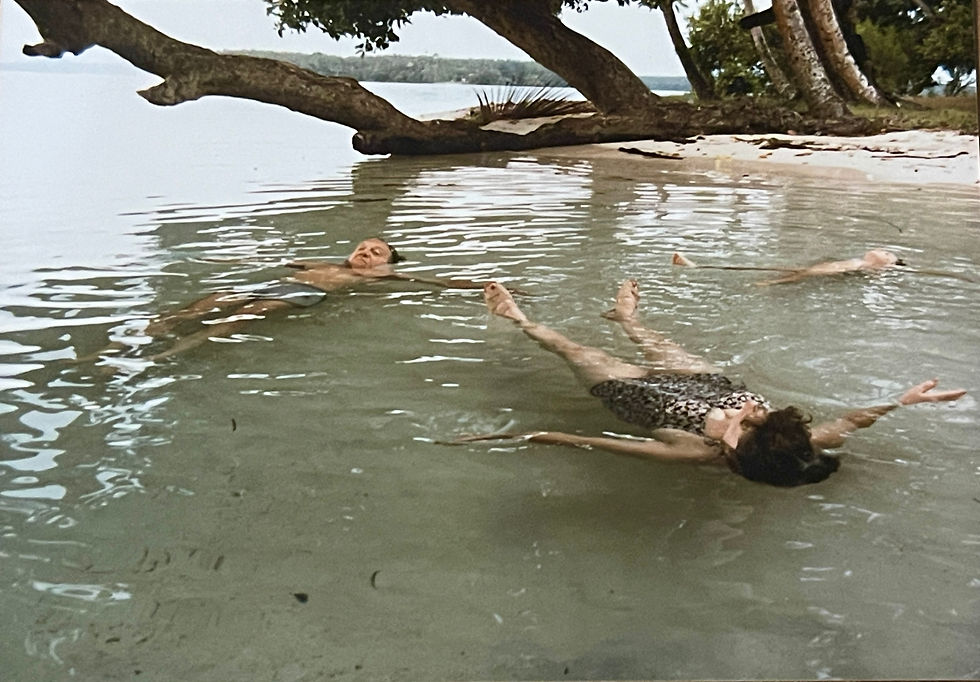
My ex-husband visited too.
With some distance, I realized I had married the man I imagined instead of the man who existed.
Closure wasn't dramatic.
It was simply seeing clearly.

The hardest memories are the ones involving Anika
.
I felt I had to be both mother and father.
Tender and comforting. Fierce and protective.
I don't know if I got the balance right.
Living alone in a developing country meant that no-one would come to save us.
I was the savior.
I wasn't always patient. I was often tired. Sometimes messy and sad.
Sometimes I put my needs before hers.

Looking back now, Papua New Guinea wasn't where I learned certainty. It was where I learned to live without it.
I learned that institutions are run by imperfect people. That good doctors can be cruel. That fathers can be loved and left. That marriages can end without hatred. That children don't need perfect parents; they need steady ones.
Most of all, I learned that adulthood isn't something that arrives one day. It accumulates quietly; through decisions one makes.
Those three years didn't simply change my life.
They became the life from which I have lived ever since.


Em i ples bilong guria na graun i pairap. Olsem bel bilong yu. Behain yu kirap strongpela tru!